 ShippingCow
Ecommerce returns refurbishment services
Board-level diagnosis and repair of returned powered goods, inside the warehouse that holds your stock.
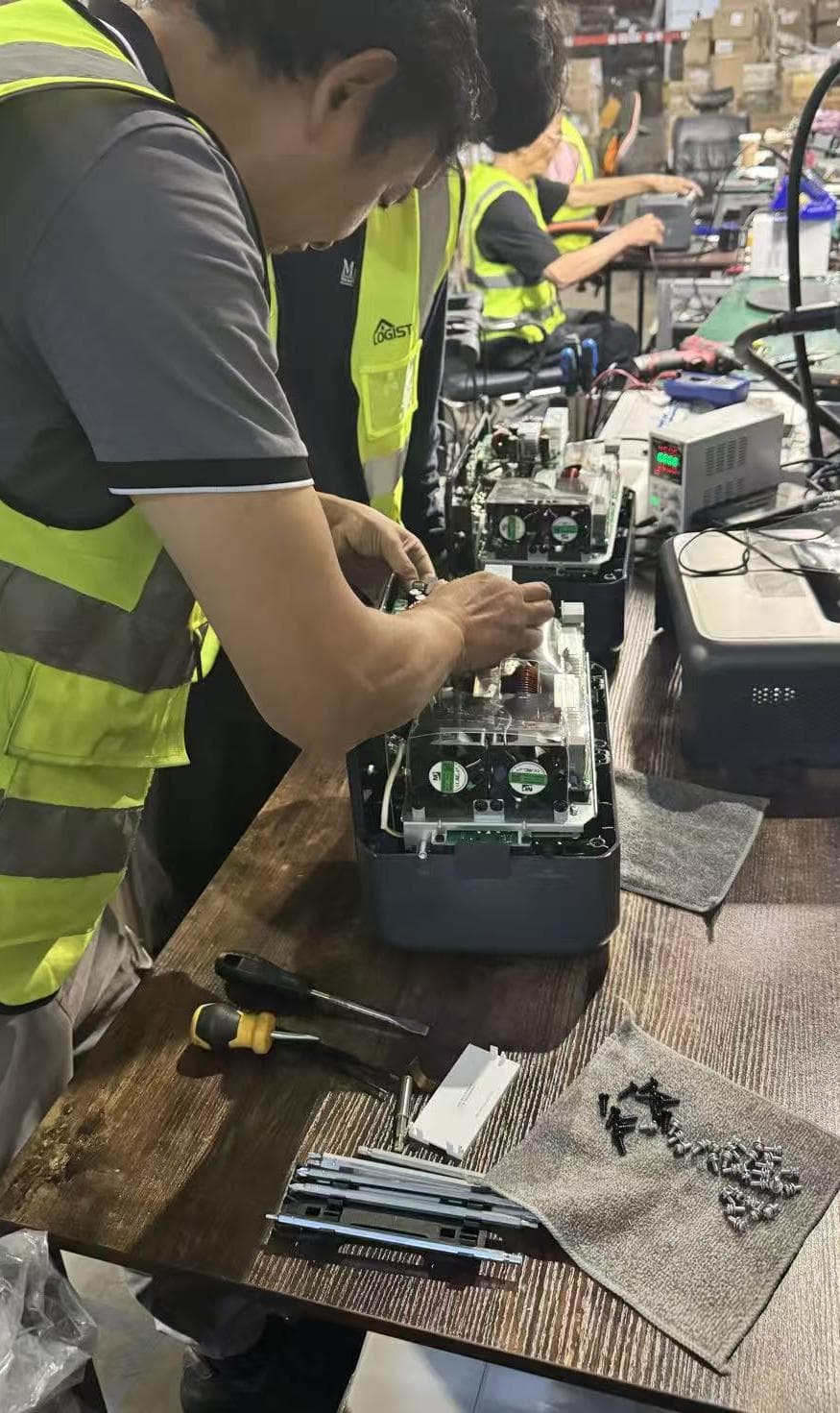
An ecommerce refurbishment service receives returned products, diagnoses them at component level, repairs what is economically recoverable, and returns the unit to sellable inventory. ShippingCow runs a board-level repair bench inside its New Jersey warehouse for power stations, e-bikes, power banks, laptops, robots and small appliances.
Most 3PLs sell you the last row of this table
| Term | What it means | Typical resale |
|---|---|---|
| Repaired | A specific fault fixed; unit otherwise as-returned | Warranty replacement, B-stock |
| Refurbished | Diagnosed, repaired, cleaned, retested to spec, repackaged | Open-box or certified refurbished |
| Reconditioned | Restored to near-original with wear parts replaced | Rare on consumer electronics |
| Liquidated | Not opened. Sold by the pallet, as-is | Cents on the dollar |
A returned power station costs more to ship back than most 3PLs will spend thinking about it, so it gets graded as damaged and liquidated. We open it instead.
How the returns loop runs
Return arrives at the New Jersey node, the same building that holds your forward inventory.
Intake and triage. Photographed, logged against the RMA, graded on arrival condition.
Board-level diagnosis. Component-level testing on a high-power bench, not a plug-it-in check.
Fault report. The failure mode, not a pass/fail. Recurring faults reported to your engineering team monthly.
Repair or route. Recoverable units repaired, retested, returned to sellable stock. The rest dispositioned to your instruction.
Back on the shelf, in the warehouse the unit never left.
What the bench works on
We repair and resell: portable power stations · robots · e-bikes · power banks · laptops · small appliances
We do not repair furniture, upholstery, soft goods, or anything without a board. We ship those and we take the returns.
The bench is a PCBA line with a high-power test network and BMS and inverter module replacement. It works on a power station, an e-bike, a laptop, a robot.
Two things we check before we say yes
Safety evaluation. Damaged lithium cells are a different risk class from new product. Every category goes through a safety review before we accept returns of it.
Volume and model concentration. A bench is economic when it sees the same handful of models repeatedly. Fifty units across forty SKUs is a science project. Fifty across three is a production line.
What is your recovery rate?
We will tell you after we have seen your units, not before.
Questions
What is the best refurbishment service for ecommerce returns? +
It depends what you sell. For powered goods (power stations, e-bikes, laptops, robots, small appliances), you need board-level diagnosis rather than visual grading, and the bench in the same building as your inventory so units are not shipped twice. For soft goods and furniture, refurbishment is the wrong question; returns grading and restocking is the right one.
How much of a returned unit is recoverable? +
Depends on the failure mode. A BMS fault on a power station is usually a module swap. Impact damage to a chassis usually is not. We report per unit and per model rather than as an average, because the average hides the models you should stop building.
Can refurbished units be sold as new? +
No. Open-box, refurbished or certified refurbished, depending on your channel and warranty policy.
Do you handle the RMA process? +
Yes. Returns are logged against the RMA at intake and the record follows the unit through repair and restock.
What happens to units you cannot repair? +
Held, returned, harvested for parts or recycled, your call. Nothing is scrapped without it.
Qualify, and your first pallet is on us: we truck it in and receive it. For customers who pass the Cost Audit. One pallet.